In contemporary oral rehabilitation, aesthetics has moved from being a subjective interpretation to a metric-based, plannable, and predictable discipline. A Dental Design Smile represents the convergence of the patient’s individual biology and Computer-Aided Design (CAD) planning, guided by high-quality intraoral and facial records obtained by the clinician in charge of the case.
True clinical success lies in managing the complex interaction between the three-dimensional maxillary position, tissue dynamics, and digital planning support with high-standard criteria, as well as the selection and structural resistance of the latest generation of restorative materials.
1. Facial analysis: The initial design reference
A frequent error in the digital workflow consists of designing based solely on the intraoral model (STL file) in isolation. However, excellence as smile by design dental specialists begins with the integration of facial parameters that function as master coordinates:
- Lip Support and Incisal Position: The location of the upper incisors influences not only phonetics but also the complete facial profile. Precise adjustments in torque can improve lip support and rejuvenate the lower third of the face in a minimally invasive manner.
- Bipupillary Line and Frankfurt Plane: These are essential references to avoid occlusal plane tilts or asymmetries relative to the facial axis. Without these orientation points, even a technically correct design can result in visual discordance.
- Buccal Corridor and Lateral Negative Space: An advanced aesthetic approach must evaluate the balance between arch expansion and naturalness. The specialist must decide whether to modify the buccal surfaces or maintain proportions that avoid an artificial effect.
2. Critical parameters in digital Wax-ups (CAD)
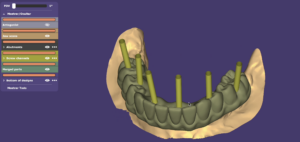
The transition from analog to digital wax-ups allows for micrometric precision. Nonetheless, for the result to be clinically functional, the specialist must master key variables within the software.
A. Zeniths and Gingival Architecture CAD design allows for projecting the ideal position of the gingival margin, facilitating interdisciplinary planning. This is fundamental for determining, before starting treatment, whether procedures such as gingivectomy or crown lengthening will be required. Through digital planning, we can obtain this projection, and in clinician-patient communication, a decision will be made defining the pros and cons of the treatment according to the patient’s needs. The symmetry of the zeniths defines much of the so-called “pink aesthetics,” an essential component in high-level rehabilitations.
B. Thickness Maps and Restorative Biomechanics One of the greatest advantages of specialized design is real-time thickness monitoring. Designing a 0.3 mm veneer, for example, requires the system to warn when the biological or restorative space is insufficient. For this reason, it is fundamental to perform a mock-up test considering these parameters and obtain approval of the design from the patient in the clinic. This initial design must be faithfully reproduced once the preparation is performed; it is always recommended that if thickness adjustments are required, a second mock-up test be performed to achieve 100% patient satisfaction. This control ensures that after milling, the material retains its structural integrity and optical properties, minimizing the risk of buccal over-contouring or unnatural results.
C. Incisal Table and Protected Occlusal Function Aesthetics must never compromise occlusion. The design of the palatal surfaces and the disocclusion guides (anterior and canine) must be modeled with precision to avoid interference during excursive movements. Proper planning reduces mechanical stress and significantly increases the clinical longevity of the restorations.
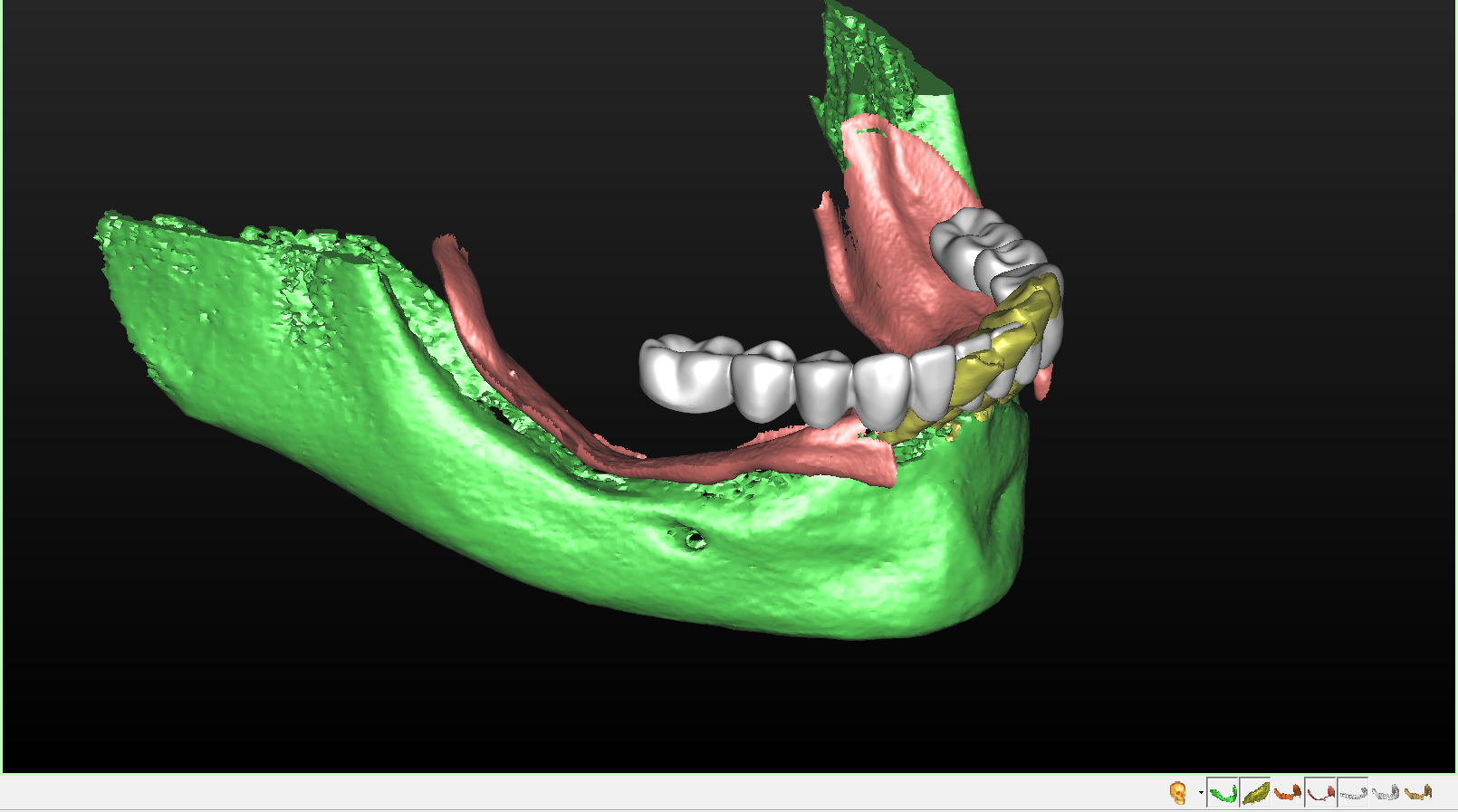
3. File Integration: The virtual patient data triangle
Specialization in the digital workflow requires the ability to merge multiple sources of information to build a complete three-dimensional model of the patient:
- STL/PLY/OBJ (Surface): Dental morphology and gingival contour.
- Clinical Photography and Facial Scanning: Real-world reference of texture, color, and smile dynamics.
The precise superimposition of these elements transforms the digital design into a reliable clinical roadmap, allowing for highly predictable treatments.
4. The Mock-up: aesthetic and phonetic validation
Even the most advanced design must be validated in the mouth. The provisional mock-up remains a critical step for evaluating both aesthetics and function. Phonetic tests provide fundamental clinical information:
- Labiodental Phonemes (F/V): Verify the relationship of the incisal edge with the lower lip.
- Sibilant Phonemes (S): Confirm the interocclusal space and avoid hissing or functional discomfort.
The value of specialized digital planning
A Dental Design Smile is a process that minimizes clinical uncertainty and raises the standard of predictability in oral rehabilitation. When CAD design is executed with scientific rigor, the result is not only visually harmonious but also biologically integrated, functional, and durable. Mastering these protocols allows clinics and laboratories to work under the same language of precision.
Shall we discuss your next case?
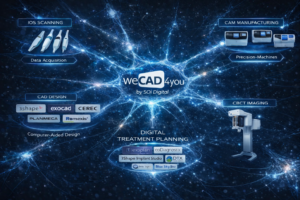
Precision in design is what transforms a conventional rehabilitation into a high-level aesthetic solution. At WeCad4You, we specialize exclusively in being the digital brain your clinic or laboratory needs, offering CAD services that guarantee excellence, predictability, and superior aesthetic results.
Do you have a complex case you want to plan with maximum technical security? We are ready to talk and show you how we can help you raise the standard of your results.