Recently, representing WeCAD4You, I had the opportunity to participate for the second time in the LMT LabDay, held from February 19 to 21, 2026.
As is customary during this intense event of interaction with different stakeholders in the dental industry, I had the chance to reconnect with my good friend Frank Acosta from AA Dental Design Inc. During one of his lectures, Frank presented his conceptual framework regarding the level of understanding required for an effective networked digital workflow.
Inspired by his presentation, and considering the current state of the art in the relationships and technological development within digital dentistry, I would like to share with you a somewhat deeper perspective on how collaboration among the various actors in this industry can generate not only excellent dental outcomes but also a substantial improvement in the quality of life of the ultimate beneficiaries of our work—our patients.
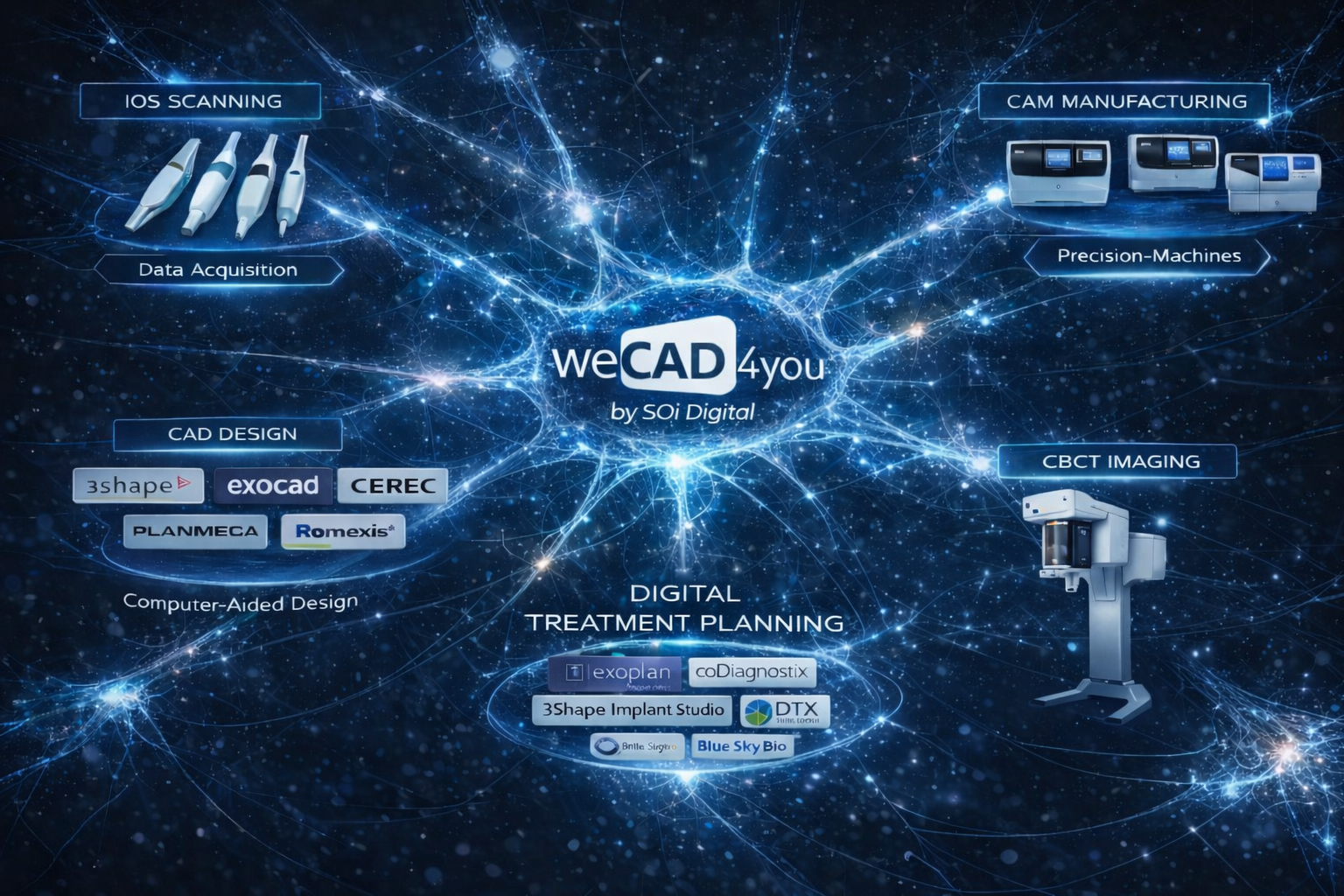
Contemporary digital dentistry is often presented as a seamless technological pipeline composed of scanners, software platforms, and automated manufacturing systems. While this representation highlights the impressive capabilities of modern equipment and algorithms, it risks obscuring the most critical element of the system: human clinical intelligence. A more accurate conceptual model is to view the digital dental workflow as a neuronal network in which the clinician’s reasoning functions as the central neuron orchestrating the flow of information. In this framework, digital tools do not replace professional judgment; rather, they amplify it.
A “Neuronal” Metaphor for Digital Dentistry
The neuronal metaphor provides a powerful way to understand the architecture of digital dentistry. In biological neural systems, the soma (cell body) integrates incoming information from dendrites, processes it through complex biochemical mechanisms, and transmits the resulting signals through axons and synapses to other neurons. Similarly, in digital dentistry, multiple sources of patient information converge into a central point of analysis and decision-making: digital treatment planning.
In this model, Digital Treatment Planning functions as the soma of the network. It is the integrative hub where all diagnostic information is evaluated and translated into a coherent clinical strategy. The clinician analyzes anatomical structures, prosthetic requirements, biomechanical constraints, and patient-specific factors before determining the appropriate course of treatment.
“Dendrites”: Data Acquisition and Diagnostic Inputs
Just as dendrites collect signals from the surrounding neural environment, modern diagnostic technologies collect diverse streams of patient data that feed into the planning process.
One of the primary sources of information is intraoral scanning, which captures highly detailed three-dimensional representations of dental structures. Platforms such as DS Core from DS, DentalShare from EXOCAD among other, allow clinicians and technicians to obtain accurate digital impressions that replace conventional analog molds. These scans provide precise surface geometry of teeth and soft tissues.
Another essential diagnostic input is cone beam computed tomography, obtained through CBCT systems. CBCT imaging provides volumetric radiographic data that reveals internal anatomical structures such as bone density, nerve pathways, and sinus cavities. This three-dimensional diagnostic capability has transformed implantology and surgical planning by allowing clinicians to evaluate anatomical constraints before any intervention occurs.
Additional sources of information may include facial scans, occlusal analysis, and patient-specific data related to function, esthetics, and systemic health. Each of these inputs functions like a dendritic signal feeding into the central clinical neuron.
“Synapses”: Software Integration and Data Exchange
In biological systems, synapses allow neurons to communicate through electrochemical signaling. In digital dentistry, this communication occurs through software platforms that exchange and integrate different types of data.
Several advanced planning environments exemplify this role. Programs such as RealGuide® , Exoplan®, coDiagnostiX®, 3Shape Implant Studio®, and DTX Studio® integrate CBCT data with surface scans to create comprehensive virtual models of patient anatomy. These platforms allow clinicians to simulate implant placement, prosthetic restorations, and surgical outcomes before treatment begins.
The synaptic metaphor is particularly appropriate because these platforms do not merely store data; they transform and transmit it. Surface scans are aligned with radiographic volumes, prosthetic designs are linked to implant positioning, and surgical guides are generated from these combined datasets. Each exchange represents a synaptic transmission within the digital ecosystem.
“Axons”: Translating Planning into Physical Outcomes
Once treatment planning decisions are finalized, the processed information travels through the equivalent of axons—digital workflows that convert virtual designs into physical objects.
This stage includes computer-aided design (CAD) and computer-aided manufacturing (CAM). CAD systems enable technicians and clinicians to design crowns, bridges, implant abutments, Dentures (Full and partials) and surgical guides, among many other appliance, with high precision. These designs are then transmitted to CAM systems, where milling machines or 3-D printing manufacturing devices fabricate the physical components.
The manufacturing stage may involve milling ceramic restorations, producing titanium implant components, or printing surgical guides used during implant placement. The axonal pathway thus represents the translation of clinical reasoning into tangible therapeutic tools.
Human Intelligence as the Central Integrator
Despite the sophistication of modern digital technologies, the effectiveness of digital dentistry ultimately depends on human interpretation, coordination, and decision-making. Digital systems can capture, process, and visualize large volumes of anatomical and prosthetic data, but they cannot independently determine the optimal therapeutic strategy for an individual patient. Clinical expertise remains essential at every stage of the workflow.
The clinician must interpret radiographic findings, evaluate prosthetic requirements, understand biomechanical forces, and consider the patient’s functional and esthetic expectations. Decisions regarding implant positioning, occlusal relationships, restorative materials, and surgical approaches require professional judgment that extends beyond computational analysis. Even when advanced software platforms such as RealGuide® (among others) provide powerful simulation tools, their outputs must be interpreted and validated within a broader clinical context.
In addition to individual expertise, successful digital workflows increasingly rely on collaborative networks of specialized professionals. The complexity of modern treatment planning—particularly in implantology, full-arch rehabilitation, Complete removable dentures, and interdisciplinary cases—often requires the integration of multiple competencies, including radiographic analysis, prosthetic design, surgical planning, and precision manufacturing.
Within this collaborative framework, specialized service providers can play a crucial role in supporting clinicians and dental laboratories that may not have the infrastructure or personnel required to manage every stage of the digital workflow internally. Companies such as WeCAD4You exemplify this model by functioning as professional hubs within the digital ecosystem.
Led by prosthodontic expertise and supported by certified dental technicians and dentists, such organizations provide structured support for clinicians and laboratories that need to outsource part—or even the entirety—of the digital workflow. Their role may include the integration of intraoral scans and CBCT datasets, prosthetically driven implant planning, CAD design of restorations, and preparation of files for CAM manufacturing or surgical guide production.
This type of specialized collaboration helps ensure that the data flowing through the digital network is interpreted correctly and translated into clinically sound decisions. By combining technological infrastructure with prosthodontic knowledge and technical expertise, a service center like WeCAD4You effectively strengthens the “central nervous system” of the digital workflow.
For many clinicians and laboratories, this model allows them to access advanced digital capabilities without needing to replicate every technology internally. More importantly, it ensures that the technological tools remain guided by experienced professionals who understand both the biological and prosthetic principles underlying successful treatment.
In this sense, the human integrator in digital dentistry is not always a single individual but often a coordinated professional network. When clinicians, technicians, and specialized digital service providers collaborate effectively, the digital ecosystem functions much like a well-organized neural network—integrating information, transmitting knowledge, and producing precise therapeutic outcomes that ultimately serve the patient.
The Ethical and Clinical Objective: Improving Patient Quality of Life
The ultimate purpose of this digital ecosystem is not technological sophistication but patient benefit. Every component of the digital workflow—from scanning and imaging to design and manufacturing—serves the overarching goal of improving the patient’s quality of life.
Digital dentistry allows treatments to be more predictable, minimally invasive, and efficient. Implant placement can be guided with high precision, restorations can be fabricated with superior fit, and treatment outcomes can be visualized before procedures begin. These advantages translate into shorter treatment times, improved esthetic outcomes, and greater patient comfort.
By: Dr. Daslav Ilic