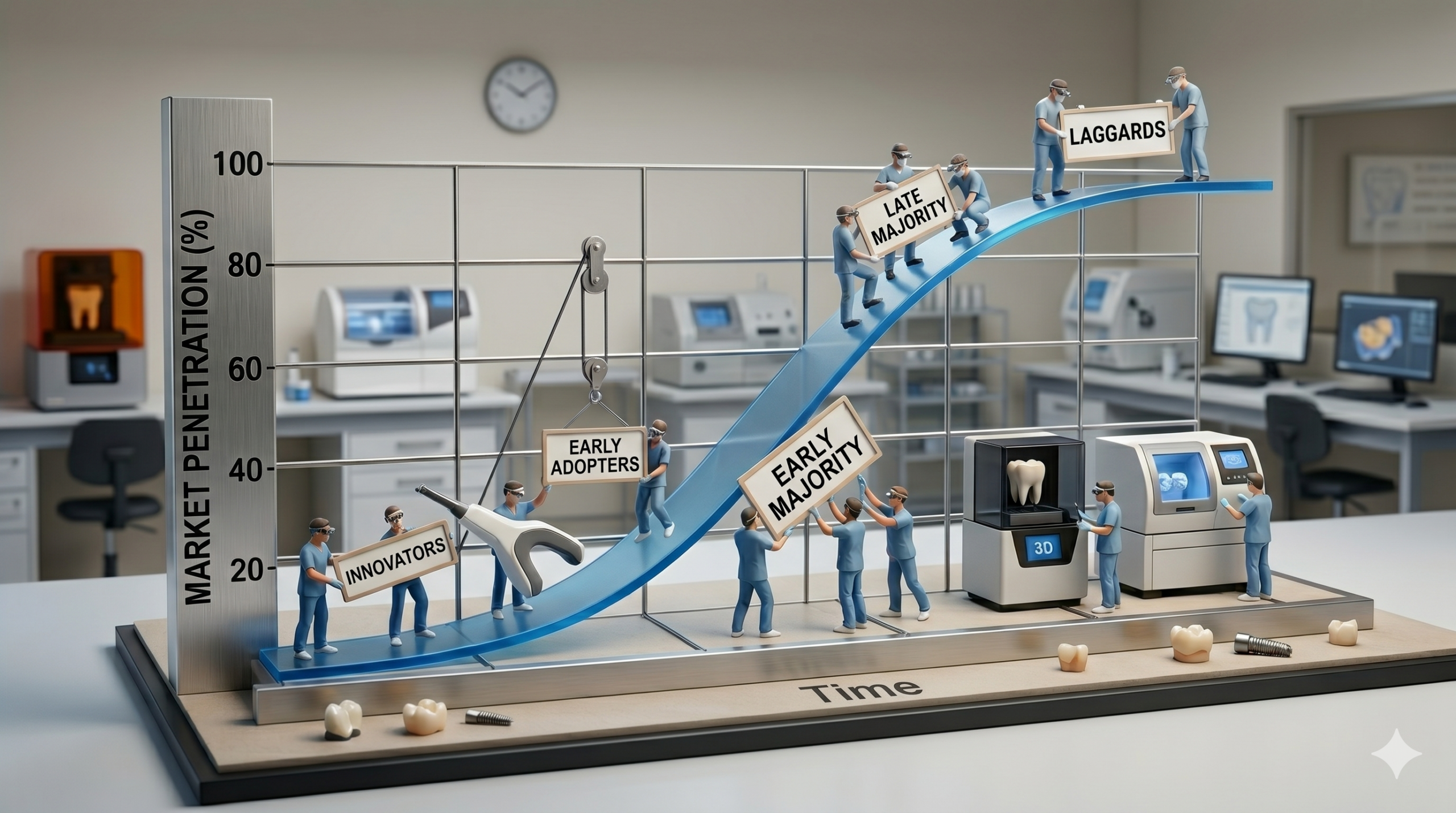
Before discussing the scope of this question and its possible answers, it is important to understand the following two curves, from whose graphs the different types of consumers or users of a new technology, as well as the timing with which they adopt it, can be derived:
Table 1
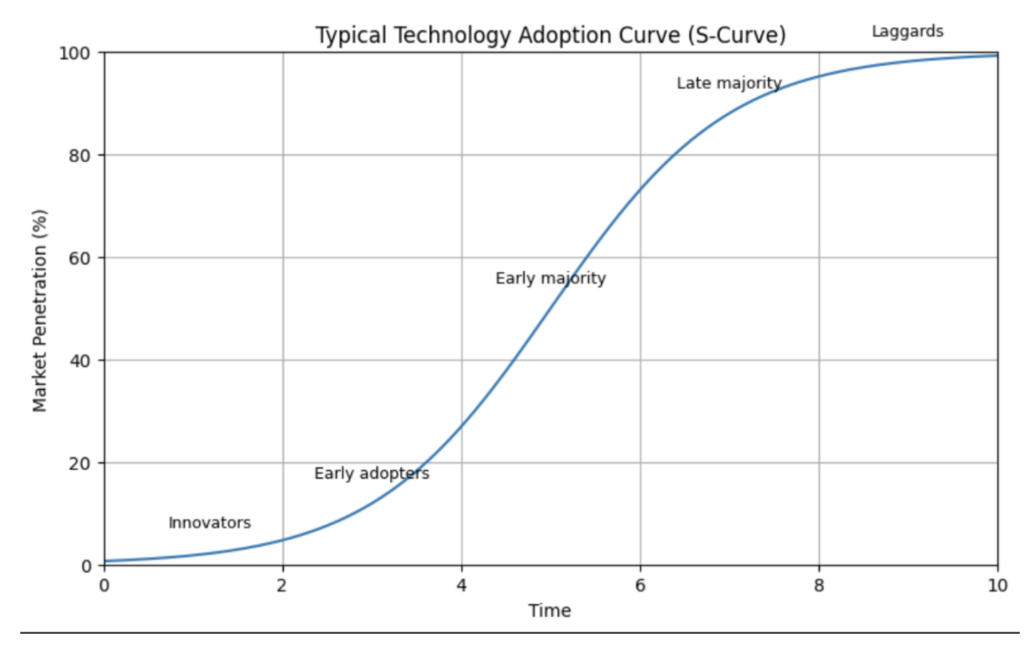
Table 2
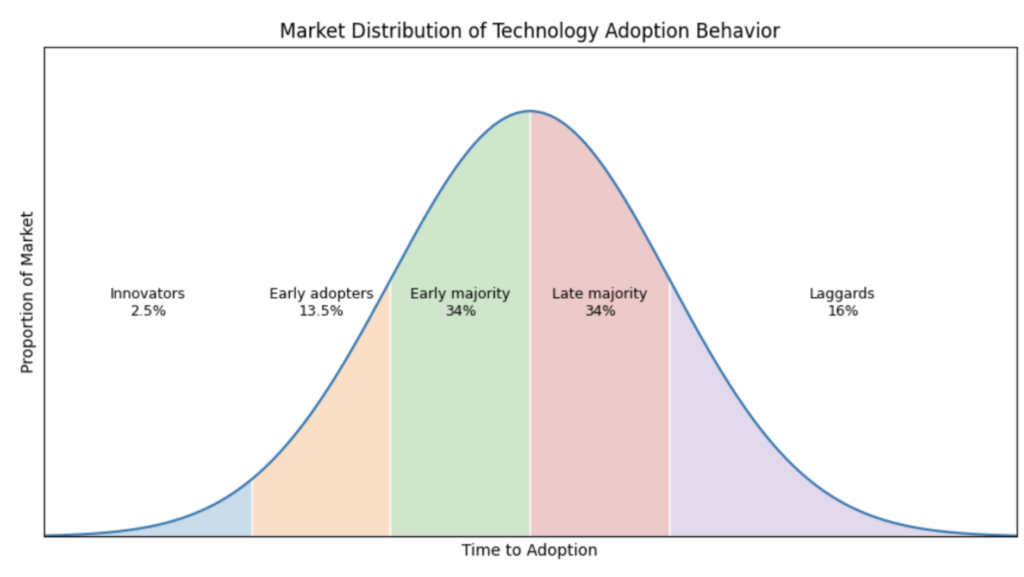
These graphs show how the different market participants (types of consumers) incorporate or adopt new technologies.
In market development, it is said that a technology is mature for commercialization once it surpasses 16% market penetration, after innovators and early adopters have already incorporated these technologies. The challenge begins to emerge in relation to the technological development of the industry and the consumer’s ability to adopt it within the early majority segment. It is within this group, as well as the following two groups, where the greatest gap exists between the average user and the technological development of the digital dental industry.
Having established this, we must also consider that these technologies continuously evolve upon themselves, repeatedly incorporating newer and more advanced technologies and workflows. In other words, if the user has not built the knowledge platforms necessary to advance to the next stage, they will always remain behind. Consequently, their understanding of how to work within advanced digital workflows will always represent a gap for them.
For companies like ours, at WeCAD4You, this situation undoubtedly represents a challenge, since each dental procedure incorporated into the different forms of digital workflows available today requires consolidating, with each specific consumer, their understanding for the appropriate use of the digital tools they possess in pursuit of the best outcome for their patient.
If we were to divide into five stages the points at which these gaps become visible, they could be explained through the following segmentation:
1. Digital Impressions
This situation has different implications for the true digital dental workflow, beginning with the knowledge of how to correctly take an intra-oral digital impression, how and when to use a conventional impression digitization technique, how to convert these elements for specific software, and how to incorporate additional digital tools such as digital photography, face scanning, or eventual computed tomography (CBCT). This is only within the acquisition phase.
2. Information and Data Transmission for Collaboration
If we now consider the process of transmitting information to a third party, for example, an outsourced or in-house digital design service, this requires a deep understanding of the platforms used for secure, reliable, precise, and legally compliant data transmission. The goal is to make this step as simple and efficient as possible, allowing both the consumer and the service provider to interact appropriately.
3. The Digital Design Process in Dentistry
The variety of options available at this stage to achieve the same result is overwhelming. For many users who have learned this process only in a chairside format, it is difficult to understand and decide how and when to use a semi-chairside protocol or a fully in-lab workflow, where, from a single digital impression, they receive the manufactured dental device ready to be installed in the patient’s mouth without any additional intermediate steps.
This phase requires all stakeholders to understand the requirements that the previous two phases must fulfill before submitting a case. It also requires identifying in which software environment a given consumer’s request can be executed. In this scenario, it is also critically important to establish close communication between the parties in order to adapt the design process to the next phase, which is manufacturing, a stage that also offers an immense variety of options and workflows.
4. The Manufacturing Phase
At this stage, the considerations taken into account during the previous three phases are critically important to obtaining the result sought by a given consumer. For this reason, once again, a close relationship must be built between the person performing the design and the one carrying out the manufacturing.
Some may say the solution is simple: the same person who designs should manufacture. The problem is that large manufacturers often suffer from the same issue described in the previous paragraphs, where comprehension of each of these stages is not guaranteed within their in-house design teams.
For this reason, there is significant demand for specialized design services such as those we offer at WeCAD4You. In this area, it is very important to identify which manufacturing tools and protocols the client will use so that the design parameters can be incorporated and adapted to that client’s specific workflow.
5. The Artist’s Preferences
Notwithstanding the understanding of the basic standards of any digital dental design process intended for a given manufacturing protocol, it is equally true that dentistry has always been both a science and an art.
In this regard, many preferences respond to the artistic styles applied to each practitioner’s work. Understanding these sensitivities among different users is also mandatory in order to achieve the most satisfactory outcome possible in the eyes of our clients.
In the seven years of development that we have accumulated at WeCAD4You, providing services to different and important players in the global digital dentistry industry, we have incorporated this understanding to better serve our clients and, above all, to deliver consistency in our work.
Most importantly, this is done to achieve the best possible result for the ultimate end user:, the patient.
We hope that in future publications we can include detailed examples and explanations of these five stages of digital workflows, enabling our followers to better understand how to make use not only of our services, but also how to choose the best digital workflow option for themselves.
By Dr. Daslav ILIĆ
Prosthodontist
Co-Founder / Director of Operations