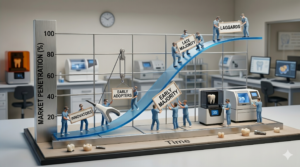
As we mentioned in the introduction to this topic, before discussing the scope of this question and its possible answers, it is important to revisit the following graph, which illustrates the different types of consumers or users of emerging technologies and more importantly, the timing in which they adopt them.
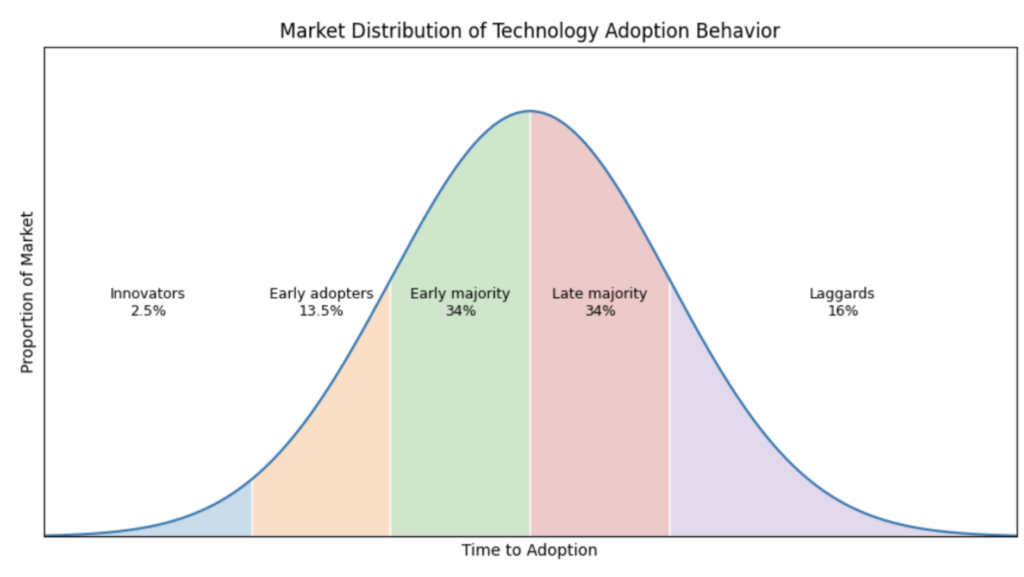
These curves demonstrate how different market participants adopt new technologies over time.
The knowledge gap between the average user and the technological development of the industry begins to emerge precisely between the “Early Majority” and the subsequent adoption groups. It is within these segments where the largest disconnect exists between the average clinician or technician and the actual technological sophistication of the Digital Dental Industry.
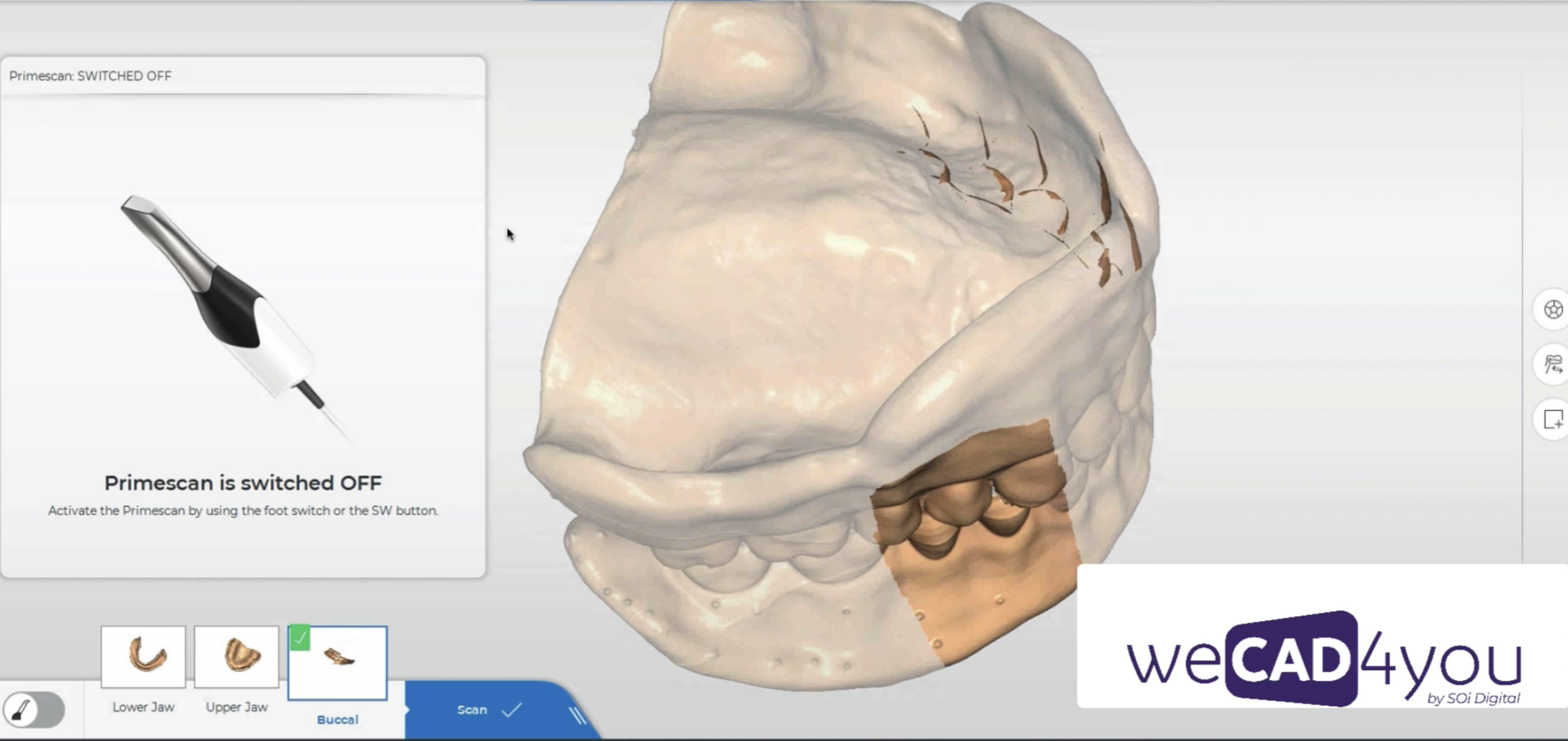
Today, I would like to explore in greater depth how this reality specifically impacts the very first stage of the digital workflow in dentistry: Digital Acquisition, or more commonly known as Intraoral Digital Impressions (IOS).
Intraoral digital impressions and digital acquisition in dentistry
What are the real gaps we need to bridge?
The primary gap between the digital dental industry and the average intraoral scanner user is not purely technological.
It is actually a combination of:
- cognitive asymmetry,
- operational maturity,
- biological understanding,
- workflow integration,
- and clinical/commercial expectations.
The industry is already operating under the logic of fully integrated digital ecosystems, while a large portion of users still utilize intraoral scanners as if they were simply a “digital impression tray.”
Understanding these gaps is essential not only for improving clinical outcomes, but also for building smarter workflows, increasing efficiency, reducing remakes, and ultimately creating better experiences for both clinicians and patients.
1. The conceptual gap
“Capturing images” vs “Acquiring biological data”
The most important gaps can be organized into the following categories:
The industry understands intraoral scanning as:
- three-dimensional data acquisition,
- topographic capture,
- spatial integration,
- generation of CAD/CAM-ready datasets,
- and the entry point into a complete digital workflow.
However, many average users still perceive the scanner as:
- a sophisticated camera,
- a more comfortable replacement for conventional impression materials,
- or simply a device to send STL files to the laboratory.
The consequence
The average operator often underestimates:
- soft tissue management,
- moisture control,
- margin capture,
- occlusal dynamics,
- stitching distortion,
- depth of field,
- and the optical behavior of restorative materials.
In simple terms The industry thinks in terms of “data integrity.”
Many clinicians are still thinking in terms of “taking an impression.”
2. The gap in understanding the complete digital workflow
The industry no longer designs isolated products.
It designs ecosystems. Today, the scanner is only the entry point into the digital workflow.
The true power lies in:
- CAD,
- CAM,
- cloud collaboration,
- AI-assisted design,
- smile design,
- implant planning,
- facial scanning,
- photogrammetry,
- manufacturing automation,
- digital QA,
- and data interoperability.
Meanwhile, many clinicians:
- scan,
- export an STL,
- and stop there.
Without fully understanding:
- tolerances,
- mesh behavior,
- alignments,
- effective resolution,
- file compression,
- calibration,
- or digital validation protocols.
This is one of the key reasons why many practices still struggle to unlock the full value of digital dentistry.
3. The gap between “marketing precision” and “clinical precision”
The industry frequently promotes:
- micrometric precision,
- full-arch accuracy,
- AI correction,
- seamless workflows.
But many users still do not clearly differentiate between:
- trueness,
- precision (repeatability),
- cumulative stability,
- and actual clinical relevance.
A critical problem
Many operators believe: “If the scanner generated a beautiful model, it must be accurate. But a visually clean mesh can still contain significant cumulative errors.
Especially in:
- full-arch cases,
- implant dentistry,
- extensive rehabilitations,
- and complex occlusions.
This is where proper education and workflow validation become essential.
4. The biomechanical and biological gap
Digital dentistry is advancing faster than the average biological understanding of many users.
Examples include:
- peri-implant tissue management,
- soft tissue behavior,
- emergence profiles,
- gingival compression,
- mandibular dynamics,
- and functional occlusal stability.
Many clinicians subconsciously assume that “digital” automatically means:
- better fit,
- higher precision,
- and superior outcomes.
But clinical success still depends on classical biological principles.
Digitalization does NOT eliminate:
- inflammation,
- poor tissue management,
- prosthetic mistakes,
- or occlusal problems.
Technology enhances dentistry.
It does not replace clinical fundamentals.
5. The real training gap
There is a massive difference between:
- knowing how to operate a scanner,
- and mastering advanced digital acquisition.
Industry training often focuses on:
- navigation,
- buttons,
- and basic workflows.
But advanced operators understand:
- scan strategies,
- path optimization,
- intelligent rescanning,
- reflective artifact management,
- stitching control,
- data density,
- and advanced margin acquisition protocols.
The result
Many users own extremely advanced scanners yet utilize only a small percentage of their true capabilities.
This phenomenon is incredibly common in digital dentistry today.
6. The economic and ROI gap
The industry sells:
- efficiency,
- speed,
- modernization,
- and differentiation.
However, many users struggle to integrate these systems profitably.
Because true ROI depends on:
- clinical volume,
- laboratory-clinic integration,
- reduction of remakes,
- chair-time optimization,
- standardized protocols,
- team training,
- and cultural adoption.
Without these elements, a scanner can simply become:
“An expensive device used to do the same thing as before.”
The real value of digital dentistry is not in owning technology.
It is in integrating it intelligently.
7. The interoperability and digital architecture gap
The industry fully understands:
- file formats,
- APIs,
- closed ecosystems,
- lock-in strategies,
- and CAD/CAM compatibility.
The average user often does NOT fully understand:
- the implications of closed ecosystems,
- export limitations,
- cloud dependency,
- licensing structures,
- data ownership,
- or future compatibility.
This is one of the most underestimated gaps in digital dentistry today.
Many professionals purchase hardware without fully understanding the digital architecture they are committing themselves to long-term.
8. The gap between “craft dentistry” and “data-driven dentistry”
The deeper transition is not technological.
It is epistemological.
Traditional dentistry relies heavily on:
- subjective experience,
- manual perception,
- and visual interpretation.
Digital dentistry is evolving toward:
- quantification,
- standardization,
- reproducibility,
- traceability,
- and data analytics.
Many clinicians are still mentally operating in an analog mindset while using digital tools.
Bridging this mindset gap is one of the greatest challenges and opportunities facing our industry today.
9. The generational and neurocognitive gap
Younger generations often adapt more naturally to:
- digital spatial navigation,
- virtual workflows,
- CAD thinking,
- and software integration.
Meanwhile, many highly experienced clinicians possess extraordinary biological and clinical knowledge but may face greater difficulty adapting to digital operational logic.
The industry often underestimates the cognitive transition required for this transformation.
This is why education, mentorship, and workflow simplification are becoming increasingly important.
10. The gap between expectations and clinical reality
Technology marketing frequently promises:
- speed,
- simplicity,
- automatic precision,
- and frictionless workflows.
But clinical reality remains:
- complex,
- biological,
- variable,
- and highly operator-dependent.
Digitalization certainly reduces certain types of errors.
But it also introduces entirely new categories of digital errors.
The solution is not simply adopting technology.
It is understanding it deeply enough to integrate it correctly.
Central synthesis
The biggest gap is not: “Who owns a scanner.”
The real gap is: Who understands that the scanner is only one node within a much larger biological-digital ecosystem.
The industry is already operating under:
- algorithmic,
- integrated,
- automated,
- and data-driven paradigms.
Meanwhile, many users still operate under:
- mechanical,
- isolated,
- analog,
- and traditionally procedural paradigms.
Strategic conclusion
The future evolution of digital dentistry will likely separate clinicians into three categories:
1. Instrumental users
They use technology simply as an analog replacement.
2. Integrated users
They understand complete digital workflows and ecosystem integration.
3. Advanced ecosystem operators
They integrate:
- AI,
- data analytics,
- CAD/CAM,
- automation,
- biology,
- multidimensional planning,
- and coordinated digital manufacturing.
The industry is already developing solutions for this third group.
However, the average clinical market still largely operates somewhere between the first and second stages.
Our perspective at WeCad4You
Over the past seven years at WeCad4You, working alongside important global players in the digital dental industry, we have incorporated this understanding into the way we support our clients.
Our mission has never been simply to provide services.
Our goal has been to help create efficient digital ecosystems adapted both to the current realities of the industry and to the natural progression of its technological evolution.
Above all, we remain focused on achieving the best possible outcomes for the final user of all this technology: the patient.
In our next chapter, we will explore these same “gap concepts” in the context of data transmission, communication workflows, and collaborative information exchange between clinicians and digital design services.
Stay tuned.
Dr. Daslav Ilić
Prosthodontist
Co-Founder / Director of Operations