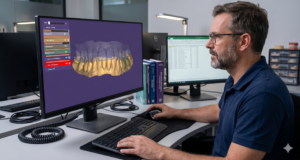
Within today’s digital dental workflow, an enormous amount of communication, collaboration, and data exchange occurs through the many digital platforms currently available on the market.
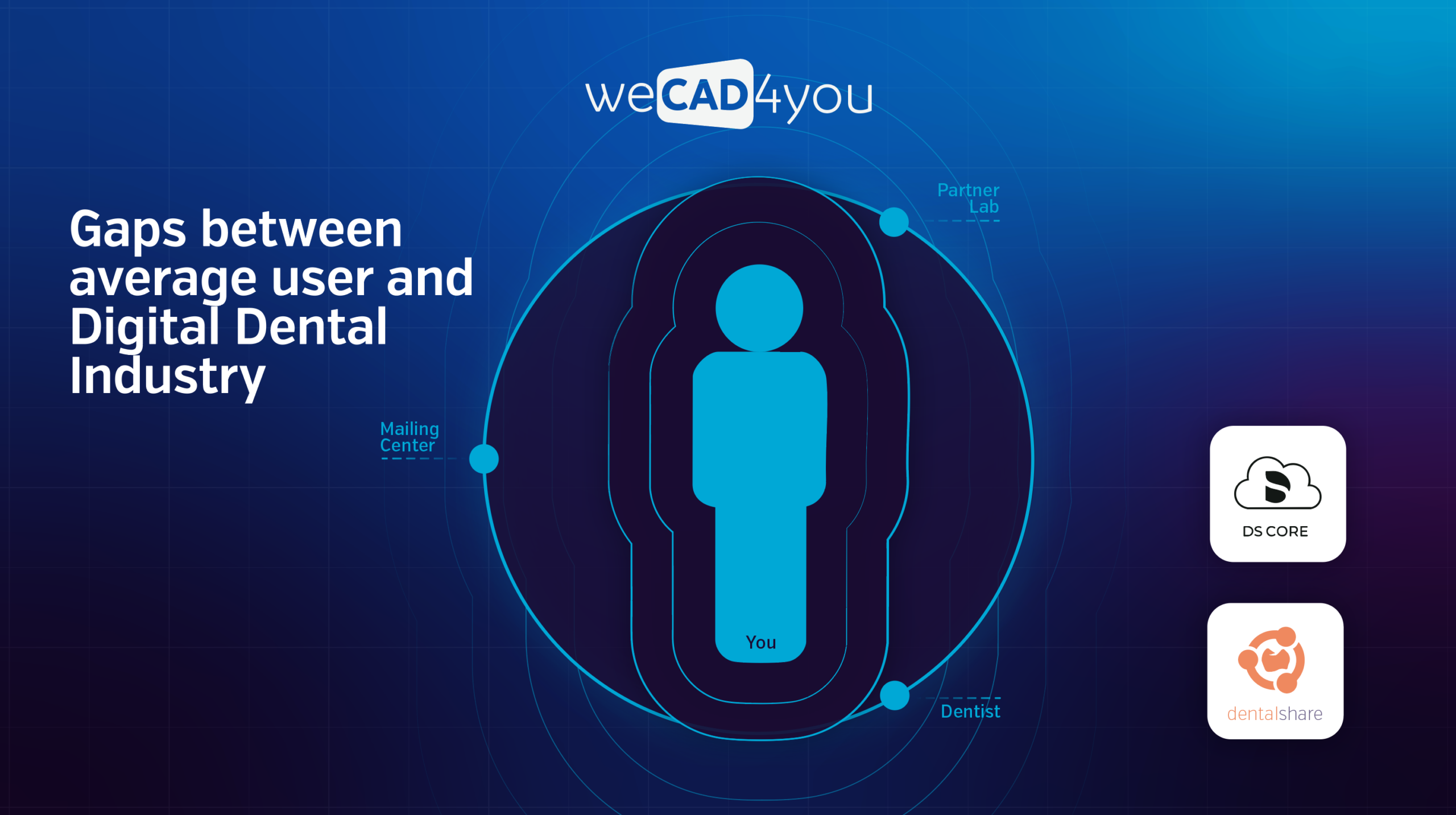
However, despite the remarkable evolution of these technologies, there is still a significant gap between the technological sophistication of the digital dental industry and the average user’s understanding of how to properly and efficiently use these platforms.
This gap goes far beyond simply knowing how to operate software. It involves:
- Workflow comprehension
- Data integrity
- Interoperability
- Communication efficiency
- Cloud collaboration
- Digital validation
- The growing complexity of modern digital ecosystems
The industry is already designing platforms under highly integrated, cloud-based, AI-assisted paradigms, while many users still interact with them as if they were merely “file-sharing websites.”
Understanding these gaps is essential if we want to improve:
- Efficiency
- Communication
- Clinical outcomes
- Laboratory integration
- The overall patient experience
Digital platforms in dentistry: where are the main gaps?
1. The conceptual gap: “sending files” vs. managing digital ecosystems
The digital dental industry views modern platforms as:
- Collaborative infrastructures
- Workflow integration systems
- Production coordination hubs
- Intelligent environments for biological and manufacturing data exchange
Meanwhile, many users still perceive these platforms as:
- Simple upload/download services
- STL repositories
- Basic communication portals between clinic and laboratory
The consequence
Many users underestimate:
- Data organization
- Traceability
- Workflow continuity
- Information hierarchy
- Digital standardization
In simple terms:
The industry thinks in terms of:
“Digital workflow infrastructure.”
Many users still think:
“Where do I upload the case?”
This conceptual difference has enormous implications for workflow efficiency and clinical predictability.
2. The gap in understanding digital file quality
One of the biggest challenges in digital dentistry today is that many users do not fully understand the technical quality of the files they share through these platforms.
The industry constantly evaluates:
- Mesh resolution
- Data density
- Geometric integrity
- Compression artifacts
- Stitching quality
- Spatial alignment
- Topographic precision
- Digital cleaning processes
Meanwhile, many users simply verify whether:
“The file opens correctly.”
A critical problem
A visually acceptable file may still contain:
- Cumulative distortions
- Margin definition loss
- Stitching errors
- Digital noise
- Excessive compression
- Insufficient spatial references
These issues directly impact:
- CAD design
- Marginal adaptation
- Occlusion
- CAM manufacturing
- Clinical outcomes
The industry understands that:
“Output quality is completely dependent on acquisition and transmission quality.”
Many users still underestimate how critical this relationship truly is.
3. The interoperability gap
The industry is making major efforts to consolidate increasingly integrated ecosystems. However, the market remains highly fragmented.
Today’s workflows often involve:
- Intraoral scanners
- CAD software
- Cloud platforms
- CAM systems
- Implant planning software
- Facial scanners
- 3D printers
- Milling units
- AI tools
- Proprietary closed ecosystems
What many users still do not fully understand
- True compatibility limitations
- Open vs. closed file structures
- Export restrictions
- API integration
- Metadata loss
- Cloud dependency
- Long-term technological lock-in
The practical consequence
Many professionals unintentionally build workflows that are:
- Partially incompatible
- Redundant
- Inefficient
- Heavily dependent on a single manufacturer
This often creates:
- Bottlenecks
- Remakes
- Operational frustration
- Hidden costs
- Inefficient communication chains
The problem is not necessarily the technology itself.
The problem is the lack of ecosystem-level understanding.
4. The workflow continuity gap
The industry is attempting to create continuous workflows that connect:
- Acquisition
- Planning
- Design
- Manufacturing
- Clinical follow-up
However, many users still operate within isolated “digital islands.”
A common example includes:
- A scanner from one company
- Partially compatible software
- A laboratory using a different ecosystem
- Manufacturing outsourced elsewhere
- Fragmented communication between all participants
The result
Digital continuity breaks constantly.
Every interruption introduces:
- Data loss
- Manual reinterpretation
- Accumulated errors
- Reduced efficiency
True digital efficiency does not simply come from becoming digital.
It comes from maintaining continuity and integrity of information throughout the entire workflow.
5. The cognitive gap regarding workflow complexity
The industry understands that modern digital dentistry is:
- Multidisciplinary
- Highly technical
- Data-driven
- Increasingly algorithmic
Many users still expect:
- Fully automatic workflows
- “Plug-and-play” simplicity
- Completely intuitive systems
The paradox
As software interfaces become simpler, the actual complexity of the underlying systems continues to increase.
This creates an important paradox:
Many users can operate the software without fully understanding:
- What is technically happening
- What types of errors may occur
- How to properly validate digital information
This is one of the defining educational challenges of modern digital dentistry.
6. The gap between automation and clinical judgment
The industry is rapidly advancing toward:
- AI-assisted workflows
- Automatic margin detection
- Automated articulation
- AI smile design
- Auto-segmentation
- Automated nesting
- Increasingly autonomous systems
As a result, many users begin assuming:
“If the software did it automatically, it must be correct.”
A critical risk
Automation can dramatically improve efficiency.
But it can also amplify errors if results are not critically validated.
The industry understands that artificial intelligence does not replace:
- Clinical judgment
- Biomechanical understanding
- Biological principles
However, many users still lack robust digital validation protocols.
This will become one of the most important professional differentiators in the coming years.
7. The communication gap between clinic, laboratory, and platform
One of the biggest challenges today is not technological.
It is communicational.
Platforms are making major efforts to simplify:
- Messaging
- Case tracking
- Approvals
- Collaboration
- File sharing
- Remote communication
Yet many workflows still suffer from:
- Insufficient clinical information
- Unclear instructions
- Poor photography
- Incomplete records
- Undefined prosthetic objectives
The consequence
Even excellent platforms cannot compensate for poor communication.
Technology does not replace:
- Clinical planning
- Interdisciplinary coordination
- Professional judgment
Efficient digital workflows still depend heavily on the quality of human communication.
8. The gap between usability and deep understanding
The industry is investing enormous resources into:
- UX/UI simplification
- Workflow automation
- Cloud integration
- Reducing user friction
- Simplifying onboarding
But there is an unavoidable reality:
Modern digital dentistry is intrinsically complex.
The central challenge
How do we simplify highly sophisticated systems without oversimplifying critical concepts?
This may become one of the defining questions of the next decade in digital dentistry.
9. The generational and neurocognitive gap
Younger generations often adapt more naturally to:
- Cloud-based collaboration
- Virtual workflows
- Software ecosystems
- Digital navigation
- Integrated platforms
Meanwhile, many highly experienced clinicians and technicians possess tremendous biological and technical expertise, but may face greater difficulty adapting to:
- Digital architecture
- Interoperability logic
- Cloud management
- Automated collaboration systems
This transition is not only technical.
It is also cognitive and cultural.
10. The gap between marketing expectations and operational reality
Platform marketing frequently promises:
- Seamless workflows
- Instant collaboration
- Automation
- Simplicity
- Effortless integration
Daily operational reality often includes:
- Incompatibilities
- Version conflicts
- Corrupted files
- Synchronization issues
- Internet dependency
- Manual validations
- Workflow interruptions
Digitalization certainly eliminates many traditional problems.
But it also introduces entirely new categories of operational complexity.
Central synthesis
The largest gap is not:
“Who has access to digital platforms.”
The real gap is:
Who truly understands how digital information flows, is validated, transformed, preserved, and integrated throughout a complex digital ecosystem.
The industry already operates under:
- Integrated
- Collaborative
- Cloud-based
- Automated
- Interoperable
- AI-driven paradigms
Meanwhile, many users still operate under:
- Fragmented
- Procedural
- Isolated
- Partially analog mindsets
Strategic conclusion
The future of digital dentistry will likely divide platform users into three major groups.
1. Operational users
They use platforms mainly to transfer files.
2. Integrated users
They understand complete digital workflows and interdisciplinary collaboration.
3. Advanced ecosystem operators
They understand:
- Digital architecture
- Interoperability
- Data validation
- Workflow continuity
- AI integration
- Automation
- Advanced multidisciplinary coordination
The industry is already developing solutions for this third category.
However, much of today’s clinical and technical market still operates somewhere between the first and second stages.
Our perspective at WeCad4You
Through years of working alongside multiple international leaders in digital dentistry, we have learned that successful digital workflows are not determined solely by:
- Scanners
- Software
- Hardware quality
The real differentiator lies in:
- Understanding the complete ecosystem
- Ensuring high-quality communication
- Properly validating digital data
- Building workflows that are coherent, efficient, scalable, and sustainable over time
Above all, we believe the ultimate purpose of all this technological evolution should remain unchanged:
Delivering better clinical outcomes and better experiences for patients.
By: Dr. Daslav Ilic