The modern dental laboratory is no longer defined by the smell of acrylic or the dust of plaster. Today, the competitive edge lies in the digital bitstream. For labs facing a saturated market and a mounting backlog of cases, the transition to a streamlined dental CAD design workflow is the only viable path to scaling without compromising clinical precision.
When we discuss the “scan to seat” protocol, we are describing a workflow where speed acts as the engine and accuracy acts as the guardrail. Here is how an optimized process, led by a professional dental CAD CAM designer, transforms a bottlenecked facility into a high-speed production center.
At a glance: The efficiency impact
- Workflow speed: Digital design can reduce total lead time by up to 40% compared to traditional waxing and casting.
- Precision: Modern CAD software achieves marginal fits within $30-50$ microns, often exceeding manual capabilities.
- Scalability: Enables labs to increase case volume by 50% without expanding their physical footprint.
The digital intake: Validating the foundation
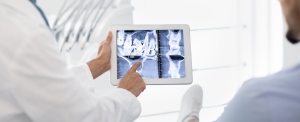
The workflow begins long before the milling machine starts. The quality of the intraoral scan (IOS) or the laboratory desktop scan dictates the entire trajectory of the restoration. A common failure in high-volume labs is rushing the intake, which inevitably leads to “digital rework.”
An expert dental CAD CAM designer performs an immediate validation of the STL or PLY files. By checking for margin clarity, scan body orientation, and occlusal clearance at the moment of arrival, the lab can request a quick re-scan while the patient is still near the clinic. This proactive step eliminates the most common cause of delivery delays.
Intelligent design: Where automation meets anatomy
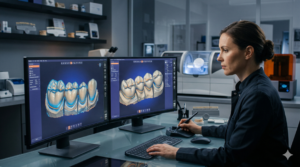
The core of the dental CAD design process involves balancing software automation with morphological intuition. Utilizing platforms like exocad or 3Shape, the designer applies specific parameters that ensure the “seat” is as seamless as the “scan.”
To optimize turnarounds, professional designers focus on:
- Nesting efficiency: Grouping cases by material and translucency to maximize disc usage and minimize tool changes in the mill.
- Customized libraries: Using high-fidelity tooth libraries to minimize manual sculpting.
- Dynamic occlusion: Implementing virtual articulators to simulate mandibular movement, reducing chairside adjustment time for the clinician.
Frequently asked questions about dental CAD workflows
How much time does dental CAD design save compared to manual waxing?
On average, a single posterior crown can be designed in 6 to 10 minutes by an experienced dental CAD CAM designer, whereas traditional waxing, investing, and casting can take several hours of active labor.
What is the standard precision for a digital restoration?
While traditional methods vary wildly, an optimized digital workflow consistently produces internal gaps and marginal fits in the 30 to 50 micron range, which is well within the gold standard for long-term clinical success.
Can outsourcing CAD design help a saturated lab?
Absolutely. By offloading the design phase to a dedicated specialist, the internal lab staff can focus on high-value aesthetic finishing (layering and staining), effectively removing the “digital bottleneck” that often stalls production.
Reducing the remake tax
The hidden cost in any laboratory is the remake. A “fast” turnaround is a liability if the restoration fails to seat. The integration of high-level dental CAD design ensures that the final output is perfectly calibrated for the specific expansion coefficients of zirconia or the milling tolerances of lithium disilicate.
By tightening this digital loop, labs offer more than just a product; they offer predictability. In a world where clinicians demand faster results, the ability to move from scan to seat with zero adjustments is the ultimate competitive advantage.