In the previous chapters of this series, we explored the gaps that exist at the level of digital acquisition (specifically intraoral scanning) and at the level of information transmission and platform management. In this third chapter, we arrive at what is perhaps the most critical and complex stage of the entire digital dental workflow: the Digital Design Process.
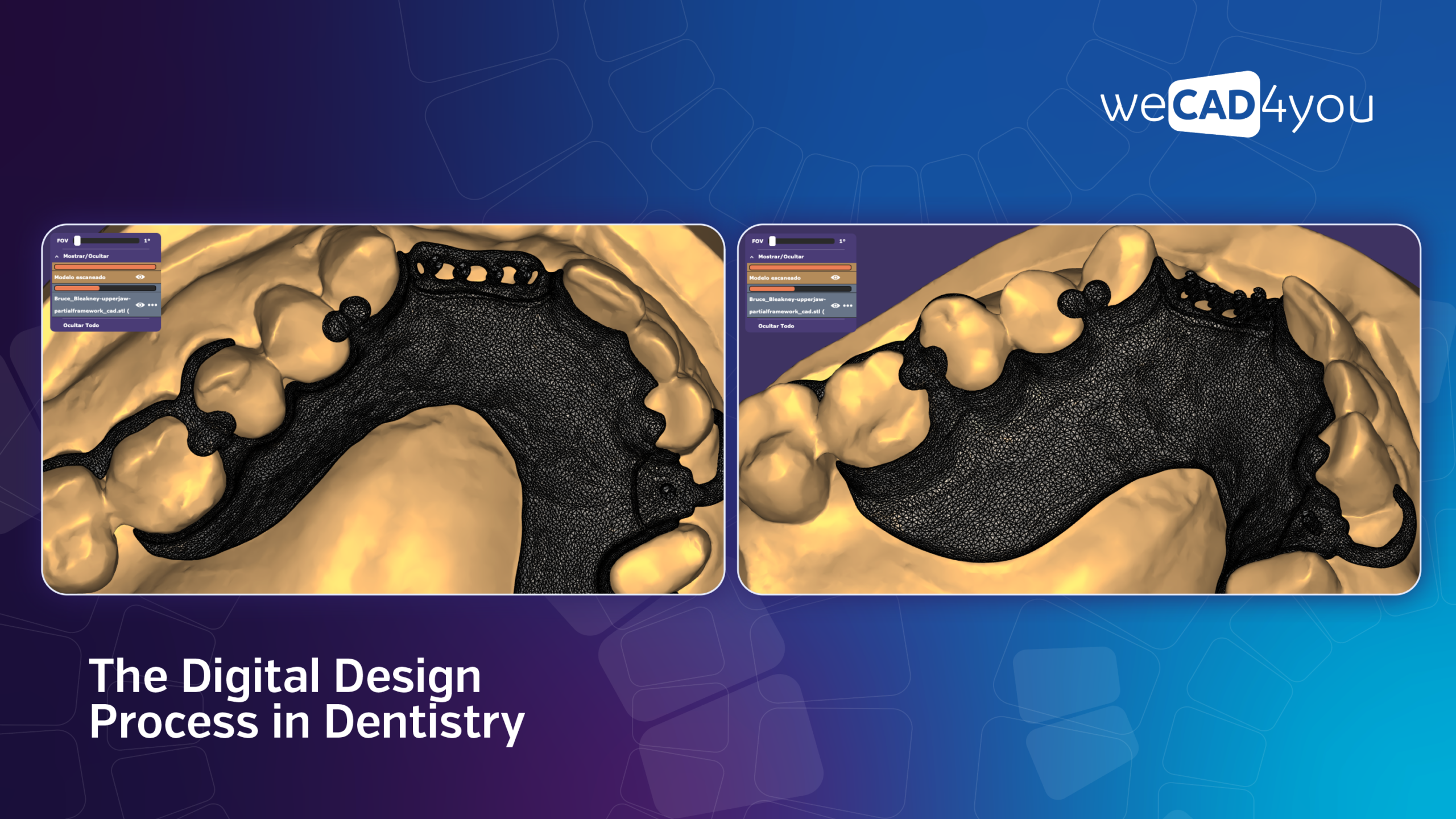
It is here where decisions made in previous stages either materialize into predictable, precise outcomes — or where accumulated errors and knowledge gaps are finally exposed. For clinicians, laboratory technicians, and outsourced design services like ours at WeCAD4You.com, understanding these gaps is not optional. It is the foundation of every successful rehabilitation.
1. The conceptual gap: “Designing a restoration” vs. “Engineering a biological solution”
The digital dental industry approaches the design process as a multidisciplinary engineering challenge. The industry thinks in terms of:
- biomechanical load distribution,
- occlusal stability and dynamic function,
- emergence profile management,
- material-specific geometry,
- marginal adaptation tolerances,
- and prosthetic space optimization.
Many average users, however, still approach digital design as an aesthetic exercise, a process of “making the tooth look right” rather than engineering a solution that performs correctly under biological and mechanical conditions.
The consequence: restorations that appear beautiful on screen but fail clinically, require remakes, or compromise patient outcomes over time.
2. The Gap in understanding the design workflow modalities
Today, digital design in dentistry can be executed through fundamentally different workflow modalities, each requiring distinct knowledge and preparation from previous stages:
- Chairside (in-office) design and milling
- Semi-chairside protocols with shared responsibilities
- Fully in-lab or outsourced design workflows
Many clinicians who have only experienced one modality (typically chairside) find it difficult to understand when and why a different protocol would be more appropriate. This lack of modality awareness directly limits their ability to choose the most efficient solution for each clinical situation.
At WeCAD4You.com, working across all three modalities for clients around the world, we have seen firsthand how this single knowledge gap translates into inefficiencies, unnecessary costs, and suboptimal clinical outcomes.
3. The Software Ecosystem Gap
The CAD software landscape in dentistry is vast and highly specialized. The industry has developed dedicated environments for:
- single-unit restorations and full-arch rehabilitations,
- implant-supported prosthetics,
- removable prosthetics and complete dentures,
- orthodontic appliances,
- surgical guides,
- smile design integration,
- and AI-assisted automated design workflows.
The average user, however, frequently operates within a single software environment (often the one bundled with their intraoral scanner) without understanding its specific limitations, strengths, or compatibility constraints relative to the clinical case at hand.
This is one of the most underestimated gaps in digital dentistry today: not knowing which software environment is most appropriate for a given clinical indication.
4. The gap between parameters and outcomes
The design process does not exist in isolation. Every design parameter must be adapted to:
- the specific material to be milled or printed,
- the manufacturing technology available to the client,
- the milling or printing tolerances of that equipment,
- the cementation or bonding protocol that will be used,
- and the biological and functional conditions of each patient.
Many users design restorations without a clear understanding of how their CAD decisions will affect the downstream CAM phase. The result is a persistent disconnect between what is designed and what can be successfully manufactured, often discovered only after the restoration fails to seat correctly or fractures prematurely.
Understanding this relationship between design parameters and manufacturing outcomes is one of the most important competencies that separates an advanced digital workflow practitioner from an average user.
5. The communication gap between clinician and designer
In outsourced or collaborative design workflows, one of the most significant limiting factors is not technical, it is communicational.
A design service can only work with what it receives. Incomplete clinical information, poor photographic documentation, undefined prosthetic objectives, and absent shade or occlusal references all directly undermine the design outcome, regardless of how sophisticated the software or the designer may be.
The industry understands that successful outsourced design requires:
- structured and complete case documentation,
- clear clinical prescriptions,
- quality reference photography,
- defined aesthetic and functional objectives,
- and iterative communication protocols.
At WeCAD4You.com, we have built our entire collaboration framework around this principle. Our intake process, platform guidelines, and direct communication channels are specifically designed to extract the clinical information needed to deliver consistent, predictable results, even in complex or atypical cases.
6. The artistic and biological calibration gap
Dentistry has always been both a science and an art. The digital design process is no exception.
Beyond technical parameters, a truly advanced digital designer must understand the individual aesthetic language of each practitioner, their preferences for tooth morphology, surface texture, translucency gradients, and gingival framing. These sensitivities vary widely and are deeply personal.
Simultaneously, biological principles must guide every aesthetic decision: the emergence profile must respect the peri-implant tissues, the occlusal contacts must follow functional principles, and the incisal guidance must protect the posterior segments.
Merging artistic calibration with biological rigor is one of the defining competencies of a truly advanced digital design professional, and one of the rarest gaps to bridge.
Central Synthesis
The largest gap in the digital design phase is not: “Who has access to design software.”
The real gap is: who understands that digital design is the convergence point of all previous workflow stages, and the preparation point for all subsequent manufacturing decisions.
The industry is already designing under:
- AI-assisted automation,
- multi-software integrated environments,
- biomechanically validated parameters,
- and manufacturing-adaptive protocols.
Meanwhile, many users still approach design as an isolated, aesthetic step, disconnected from the acquisition data that precedes it and the manufacturing reality that follows it.
Our perspective at WeCAD4You
Over seven years of working alongside leading global players in digital dentistry, WeCAD4You.com has built its practice on a single conviction: the design phase is only as strong as the ecosystem that surrounds it.
Our team does not simply receive files and produce designs. We analyze the quality of the incoming data, identify workflow gaps, communicate actively with each client to define clinical objectives, and adapt every design parameter to the specific manufacturing reality of that client’s environment.
This is what makes the difference between a service and a digital partnership.
In our next chapter, we will explore the manufacturing phase, and the gaps that exist between design intent and production reality.
Stay tuned.
By Dr. Daslav Ilić
Prosthodontist
Co-Founder / Director of Operations