A patient asks for a straighter smile but doesn’t want brackets, doesn’t want enamel reduced for veneers, and doesn’t want a visible correction running for a year. Minimally invasive smile design is the term orthodontics uses for that request: an approach built on digital planning rather than a single product, which is what makes it deliverable with consistent results.
What “minimally invasive” means in smile design
Minimally invasive smile design starts from a simple principle: change as little healthy tooth structure as possible while still correcting the problem the patient came in for. In practice, that usually means choosing clear aligners over fixed brackets for mild-to-moderate crowding, spacing, or bite issues, and reserving irreversible work like enamel reduction or crowns for cases that genuinely need it.
The appeal goes beyond looks. Aligners are removable, so patients can eat, brush, and floss normally, which lowers the risk of the decalcification spots that sometimes show up around fixed brackets. For the clinic, it also means a second track for patients who would otherwise refuse treatment because they don’t want visible hardware for a year or more.
Patients searching for this often use a different phrase: invisible braces design. It describes the same idea from their side: correction without a visible appliance, with each stage of movement mapped out before the first tray is ever worn.
How it’s planned with CAD/CAM
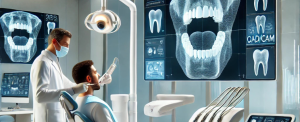
Minimally invasive only works if the plan is accurate from the start, since there’s no wire to bend mid-treatment the way there is with brackets. CAD/CAM is what makes that accuracy possible before a single tray exists.
The workflow follows the same four steps regardless of which aligner system a clinic uses:
- Intraoral scan. A digital impression replaces the old putty tray, capturing the current position of every tooth.
- Digital treatment simulation. The scan is loaded into CAD software, where the design team maps out how each tooth needs to move, stage by stage, to reach the final position.
- Plan review and approval. The clinician reviews the simulation in a 3D viewer and can request adjustments before anything is manufactured.
- Sequential aligner production. Once approved, the full set of trays is produced in CAD/CAM, each one representing a small step toward the final smile.
Because the entire sequence is modeled before treatment starts, both the clinician and the patient can see how the teeth will move and roughly how long it will take. Fixed brackets can’t offer that. There’s no equivalent plan to review before the wire goes in.
Want a design team in your time zone?
Send us a case and see how fast a same-time-zone team can turn it around.
- Zero Software Costs: Send open STL scans from any intraoral scanner and pay only per completed design.
- 24-Hour Turnaround: Receive milling-ready STL files overnight, or in as little as 6 hours for rush cases.
- Full Clinical Versatility: From single crowns to complex implant-supported bridges and surgical guides.
🚀 Focus on your patients. Let our team handle the CAD design. 👉 [Click here to claim your first free trial design with WeCAD4You]
How Wecad4you applies this to minimally invasive cases
Orthodontic appliance design and smile design integration are part of the same digital workflow Wecad4you works with across chairside, semi-chairside, and fully outsourced modalities. The same scan, simulate, review, and produce sequence used for a crown or an implant-supported bridge applies to a minimally invasive aligner case, with the design team mapping out each stage of tooth movement before anything goes to production.
That workflow runs on the same turnaround the rest of Wecad4you’s design work does: 24 hours for standard cases, and as little as 6 hours when a clinic needs a case back the same day. A minimally invasive case depends on each stage being approved and produced before the next one starts, so that turnaround keeps a multi-step aligner sequence from stalling between rounds.
Where minimally invasive design extends: younger patients
Clear aligners aren’t only an adult option. Dental pediatrics has been adopting invisible aligners too, for the same minimally invasive reasons: no enamel reduction, no fixed hardware to navigate during brushing, and a treatment a teenager is more likely to actually wear.
A 2019 University of Chile study found a 69.3% prevalence of malocclusion in children and adolescents aged 6 to 18, and a 2022 review in the Journal of Dentistry covering 14 studies across 11 countries found a near-identical 70.1%, with almost the same distribution across malocclusion classes. Aligners have been used in that age group to treat crowding, cross-bite, open bite, and deep bite, with outcomes comparable to conventional braces in published research.
A pediatric case isn’t a smaller version of an adult one, though. Growth is still happening, and the use of invisible aligners in younger patients needs supervision from a pediatric dentistry or orthodontic specialist who can judge which cases are ready for this approach and which ones still need a different kind of intervention first.
FAQ
What does “minimally invasive smile design” mean?
It’s an approach to correcting a smile that changes as little healthy tooth structure as possible, usually by choosing removable clear aligners over fixed brackets or irreversible restorative work for cases that don’t require it.
How is a minimally invasive case planned with CAD/CAM?
Through four steps: an intraoral scan, a digital treatment simulation that maps out each stage of tooth movement, a review and approval step with the clinician, and the sequential production of the aligner set once the plan is approved.
Does Wecad4you design minimally invasive cases like these?
Yes. Orthodontic appliance and smile design work is part of the same digital design process Wecad4you applies across chairside, semi-chairside, and outsourced workflows, with the same 24-hour standard turnaround (6 hours for rush cases) used for the rest of its design work.
Can minimally invasive smile design be used on children and teenagers?
Yes, with supervision. Invisible aligners are increasingly used in dental pediatrics to treat crowding, cross-bite, open bite, and deep bite, but because growth is still happening, these cases need to be evaluated and followed by a pediatric dentistry or orthodontic specialist.
How is this different from traditional orthodontic treatment?
Traditional treatment with fixed brackets corrects a wider range of cases but is visible and non-removable for the full treatment period. A minimally invasive approach fits mild-to-moderate cases better, where a removable, less visible option can reach a comparable result without the same amount of hardware.